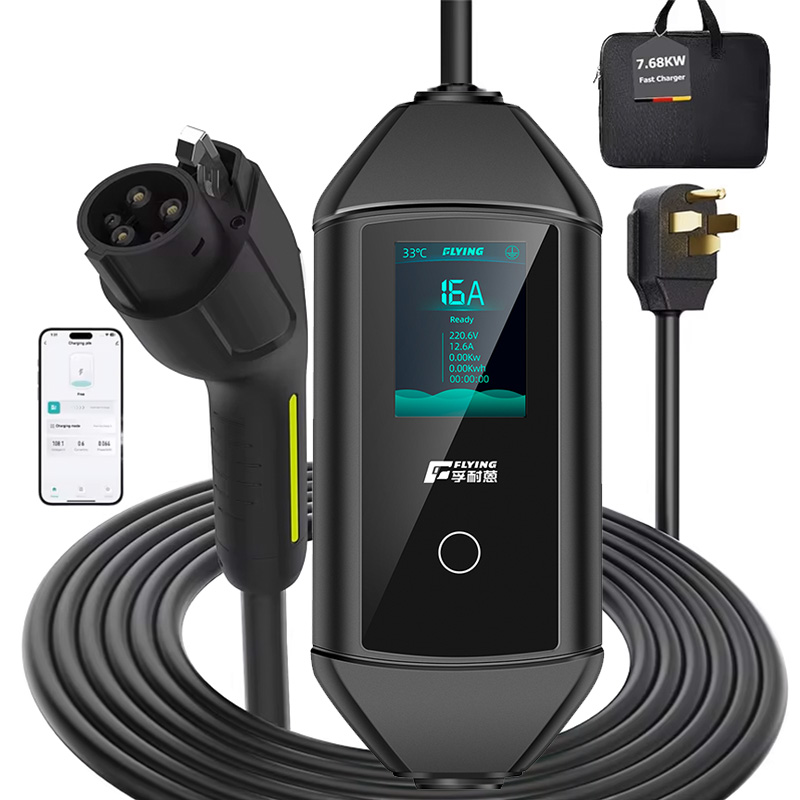

For many EV owners and installers, the installation and use of home charging stations present a practical challenge: when high-power appliances (such as central air conditioning or electric ovens) operate simultaneously, the charging process can easily trigger an overload trip on the home’s main circuit.
To fundamentally resolve system overload and power distribution issues, FLYING charging stations feature industry-leading Dynamic Load Balancing (DLB) technology. This is not merely an intelligent current-limiting solution, but an automated management system that ensures home electrical safety around the clock.
I. Operating Mechanism of Dynamic Load Balancing (DLB)
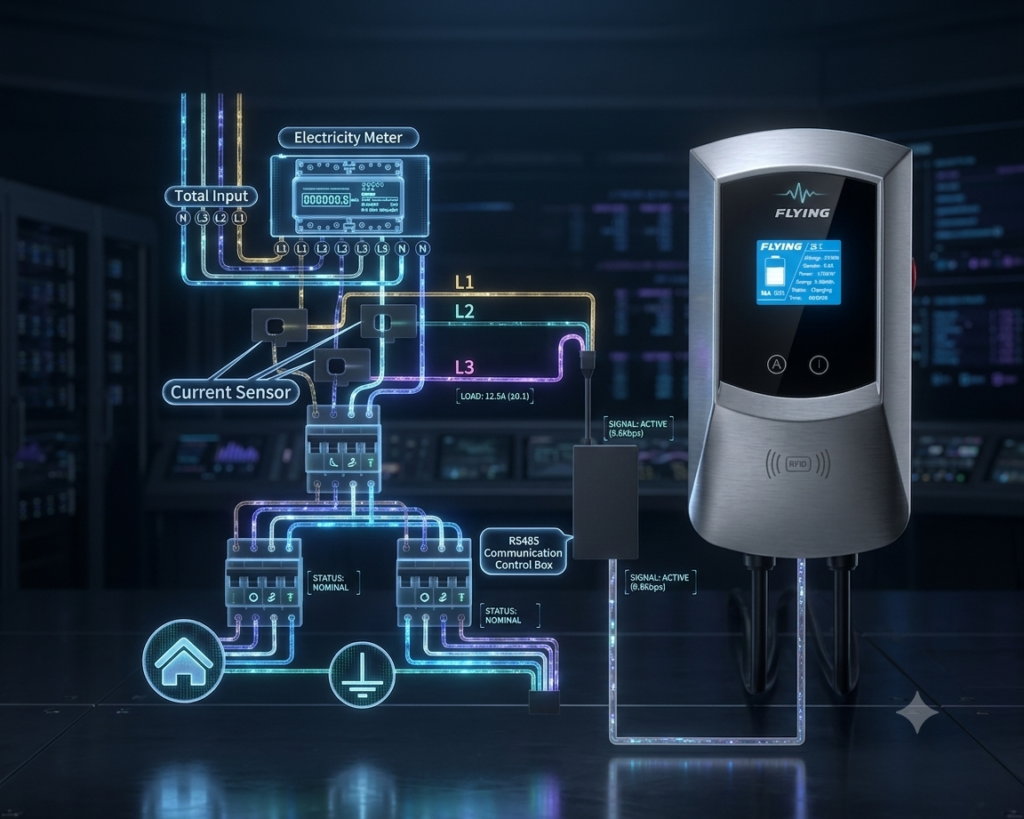
The FLYING DLB system achieves seamless coordination between household electricity consumption and charging demands through intelligent sensing and real-time regulation:
- Real-time Power Monitoring
The system employs high-precision CT sensors on the main power line to monitor the total household electrical load in real time at the millisecond level. Based on the grid’s remaining available capacity, the system automatically and precisely adjusts the EV charging current, ensuring total power consumption remains within the safety threshold of the main circuit breaker. - Millisecond-level Dynamic Response
When high-power appliances are activated, causing a surge in electricity demand, the FLYING charging station rapidly reduces its output power. Conversely, when high-power appliances are turned off and capacity becomes available, the station automatically and smoothly ramps back up to the maximum permitted charging power, balancing safety with efficiency. - Three-Phase Load Balancing Management
For high-power charging scenarios—such as 3-Phase 32A setups—the FLYING DLB system monitors and regulates the load status of each phase (L1, L2, L3) individually. By displaying real-time data, it effectively prevents grid imbalance caused by single-phase overloading.
II. Core Safety Standards
In practical application, DLB technology adheres to rigorous safety control logic:
8A Intelligent Safety Pause Threshold
The system incorporates a strict safety redundancy algorithm. As long as the household’s remaining available current is 8A or higher, the charging station maintains high-efficiency charging. If the available current drops below 8A, the station automatically pauses charging to prioritize the home’s base electrical load, then intelligently resumes operation once capacity becomes available.
Deployment and Hardware Requirements
To activate the DLB function, a FLYING DLB unit must be installed in the home’s main distribution box and connected to the FLYING charging station via an Ethernet cable.
III. Why Choose FLYING Charging Stations?
Among similar products on the market, the true differentiators of the DLB experience are millisecond-level hardware response speeds, precise three-phase balancing algorithms, and long-term system stability.
FLYING is dedicated to the R&D and manufacturing of charging infrastructure. By adhering to rigorous technical standards and offering integrated hardware-software support, we strike the optimal balance between safety protection and charging performance.
“Often imitated, never surpassed.”
📩 Technical Inquiries and Business Partnerships
If you require detailed specifications, installation guides, or bulk purchasing options regarding FLYING’s DLB technology, please contact our engineering and technical team via the following channels:
Email: ali@fyevchargingcom
Online Consultation: Click “Live Chat” in the bottom right corner to communicate directly with a technical expert.