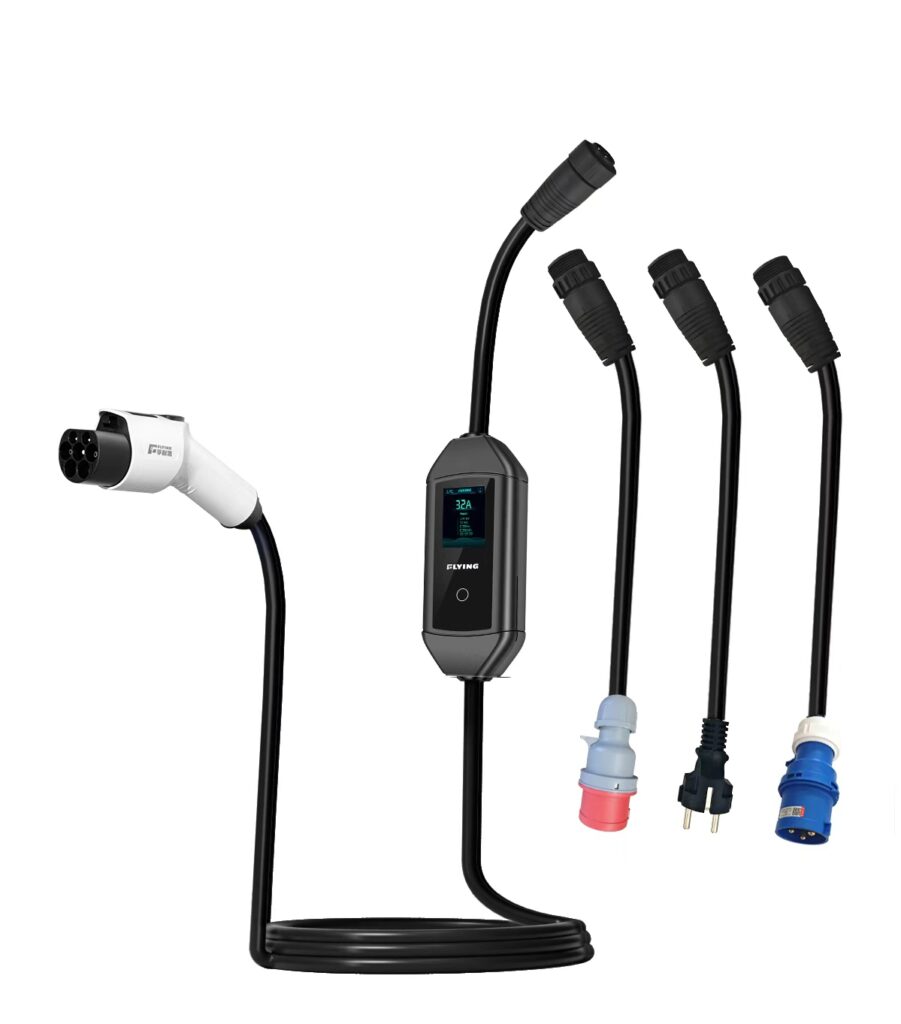
In European standard electric vehicle charging scenarios, more and more users are paying attention to CEE industrial plugs. So what’s the difference between it and a regular household socket (Schuko)? How should you choose between blue and red CEE plugs? Today, we’ll explain it all clearly.
What is a CEE Plug?
A CEE plug is an industrial-grade power connector conforming to the IEC 60309 standard, designed for high-current, high-durability power environments. In the electric vehicle charging field, CEE plugs are typically used to connect portable chargers to the power supply; it connects to the power source, not the vehicle.
Blue CEE Plug vs. Red CEE Plug: Blue CEE plugs are single-phase 230V, commonly found in home garages, campsites, etc. The 16A specification provides approximately 3.6kW of charging power, suitable for basic overnight charging; the 32A specification provides approximately 7.4kW, suitable for faster home charging needs.
Red CEE plugs are three-phase 400V, commonly found in commercial, industrial, and fleet locations. The 16A plug provides approximately 11kW, while the 32A plug provides approximately 22kW, better suited for high-power AC charging needs.
The two plug types have different physical structures and are not interchangeable.
CEE Plug vs. Schuko Socket: Schuko is a common household socket in Europe, convenient but with limited continuous charging capacity, better suited for occasional slow charging. CEE plugs are more robust and stable, better suited for long-term, fixed charging power interfaces.
When is a Wall-Mounted Charging Station Better?
While CEE plugs are more reliable than household sockets, if the charging location is fixed and charging is frequent, a wall-mounted charging station is a better long-term choice—offering smarter control, a more convenient daily user experience, and a cleaner installation.
In short: Use Schuko for occasional emergencies, CEE for stability, and a wall-mounted charging station for long-term peace of mind.